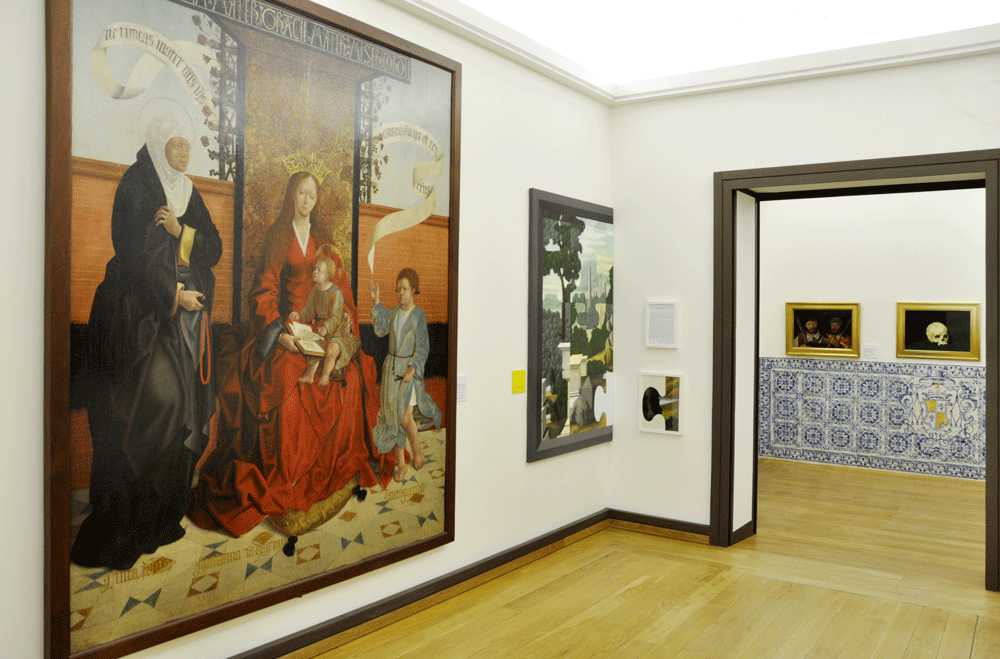
«Nimium Ne Credere Colori» at the Museum of Évora, Évora, Portugal.
23.08.2010–19.02.2011
a solo exhibition curated by António Camões Gouveia
«(...) uma moldura
uma permanência descritiva;
uma envolvência delimitadora;
um falso existente;
um traço que engana com as volumetrias do pintor;
uma dolência de querer fazer não perguntada;
um contraste entre a geometria das linhas e o criativo do volumétrico;
uma cor espessa que se deixa olhar;»
«(...) a frame
a descriptive permanence;
a defining enclosure;
a false existence;
a line that deceives with the painter’s volumes;
an unasked desire to create;
a contrast between the geometry of lines and the volume of creativity;
a profound colour that allows itself to be contemplated.»
Excerpt from the exhibition catalogue essay “Quatro perspectivas, uma moldura, muitas palavras” by António Camões Gouveia, 2010.
-
The solo exhibition "Nimium Ne Credere Colori” curated by António Camões Gouveia was held from 23 August 2010 until 19 January 2011 at the Museum of Évora, Évora, Portugal.
-
António Camões Gouveia (b. 1958, Portugal) is a historian and academic specialising in Cultural and Political History, History of Ideas, and Social History. He holds a degree in History (1978–1981), a postgraduate qualification in Cultural and Political History (1982–1983), and a PhD in History and Theory of Ideas, with a specialization in the History of Social Ideas (2005–2006), all from the Faculty of Social and Human Sciences at Universidade Nova de Lisboa.
He has been a faculty member at the same institution since 1981, teaching subjects related to the history of the 16th to 18th centuries. He is a researcher at the Centre for the History of Culture at Universidade Nova de Lisboa and a collaborator with the Centre for the Study of Religious History at the Catholic University of Portugal. His research focuses on modern mentalities, ideas, and social practices, with particular emphasis on the history of nobility, knowledge systems, religious life, and everyday culture. Between 1991 and 1997, he worked closely with the National Commission for the Commemoration of the Portuguese Discoveries. In 1998, he co-founded the company Há Cultura, dedicated to cultural industries, with a focus on performing arts and the body, as well as the production of scientific and cultural events. From 2003 onward, he served as Scientific Coordinator of the Robinson Foundation in Portalegre. He also played a key role in the development and coordination of the Second Cycle in Cultural Practices for Municipalities at FCSH-NOVA, integrating academic and cultural programming perspectives. From January 2010 to December 2011, he was Director of the Évora Museum, then under the Portuguese Institute of Museums and Conservation (IMC).
-
Fernando António Baptista Pereira (b. Lisbon, Portugal, 1953) is a university professor, curator, and museum specialist. Since 2019, he has served as President of the Faculty of Fine Arts of the University of Lisbon (FBAUL). He holds a degree in History from the University of Lisbon (Faculty of Arts, 1976), a postgraduate qualification in Museology from the former Portuguese Institute of Cultural Heritage (1984), and a PhD in Art Sciences (Art History) from the Faculty of Fine Arts of the University of Lisbon (2002). He has taught at the University of Lisbon since 1979, working across both the Faculty of Arts and the Faculty of Fine Arts. He is currently an Associate Professor with tenure at FBAUL, where he teaches Art History and Museology. Throughout his academic career, he has held several leadership roles, including President of the Pedagogical Council (2005–2012) and President of the Scientific Council (2012–2017). He was also Director of the Research Centre for Fine Arts Studies (CIEBA) between 2010 and 2016.
Pereira is the author of curricula for the degree in Art and Heritage Sciences and for the Master’s programmes in Museology and Museography at FBAUL. As an academic advisor, he has supervised hundreds of master’s dissertations and doctoral theses and has served on numerous examination juries. His scholarly production includes extensive publications, conference papers, and international communications in the fields of Portuguese art history, cultural history, art criticism, and museology. He has also contributed to the conception and programming of several museums, including the Museu do Oriente in Lisbon and the Museu do Trabalho and Convento de Jesus in Setúbal, as well as major exhibitions in Portugal, Spain, Brazil, and Macau. He has coordinated scientific catalogues for these projects and served as scientific reviewer of the New Art History of Janson, published by the Calouste Gulbenkian Foundation in 2010. Between 2017 and 2019, he served as Advisor to the Portuguese Minister of Culture in the area of Museums and Heritage.
Margarida P. Prieto is a visual artist, researcher, and professor based in Lisbon. She holds a PhD in Painting (2013), a Master’s degree in Fine Arts – Painting (2008), and a BA in Visual Arts – Painting (1999), all from the Faculty of Fine Arts, University of Lisbon. She is an Assistant Professor at Universidade Lusófona in Lisbon and an integrated researcher at the Centre for Research and Studies in Fine Arts (CIEBA). She is also a guest lecturer at the Faculty of Fine Arts of the University of Lisbon, where she teaches in the Painting BA programme. Prieto serves as Director of the BA in Visual Arts and as Director of an academic unit at the Polytechnic Institute of Lusofonia (IPLUSO), School of Communication, Innovation and Arts. Alongside her academic roles, she maintains an active artistic practice and research trajectory in the field of painting and visual arts. She has published academic articles, book chapters, and books, and has organised and participated in numerous scientific and artistic events. Her work has received awards and recognition, and her research focuses on painting, installation, site-specific practices, visual language, aesthetics, and artistic methodologies, bridging theory and practice in contemporary art.
-
On the occasion of the exhibition, a catalogue was published.