Un Cuerpo Extraño Museo Nacional de Artes Decorativas Madrid, Spain
12.02—12.05.2013
curated by José Maria Parreño


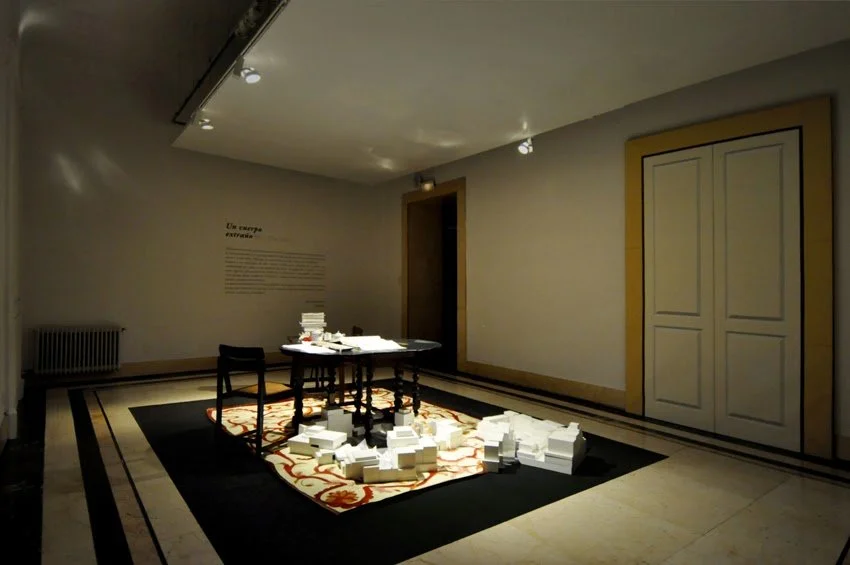

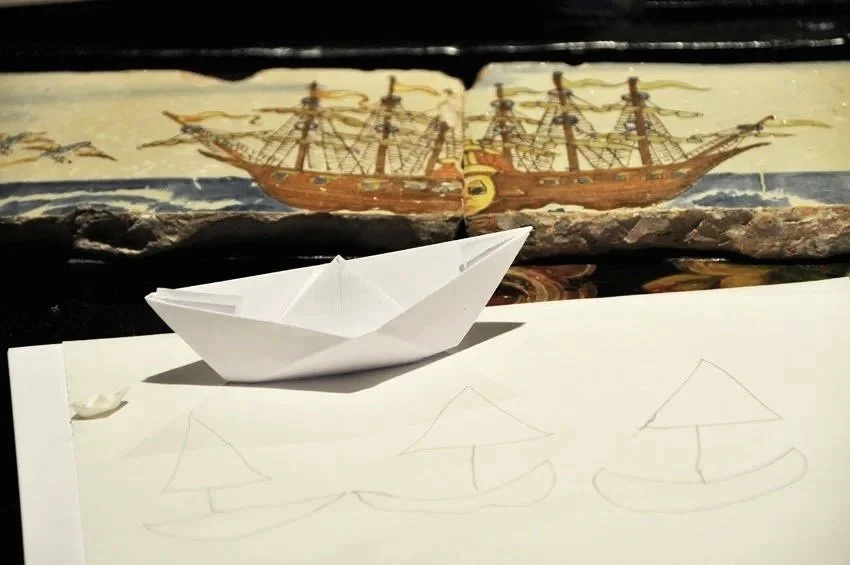
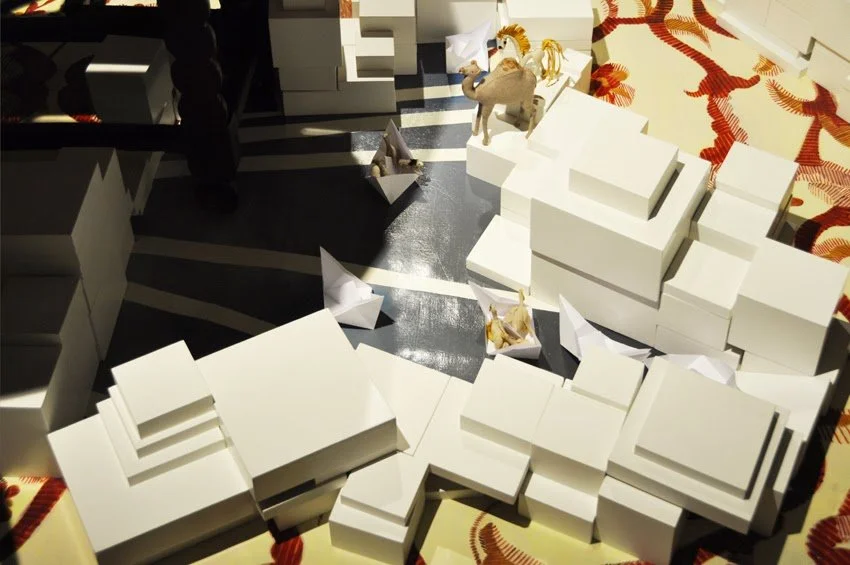


Un Cuerpo Extraño (A Foreign Body) invites us to look at the museum, its works, its routes... to take nothing for granted, to play with all seriousness. To do this, Rui Macedo uses three different means: firstly, a careful selection of works from the museum's collection that play a different role from the usual one; secondly, a drastic transformation of the space that changes the viewer's point of view; and finally, Macedo contributes a total of 66 paintings in which he uses sophisticated visual artifice. Paintings that almost never take the form of paintings, since they are either integrated into the montage or are precisely paintings that flee from themselves.
«Un Cuerpo Extraño (A Foreign Body) occupies the seven rooms on the ground floor, which are normally used for temporary exhibitions. More than a hundred pieces from the museum's collection and a total of sixty-six paintings by the artist have been distributed throughout these rooms. It should be noted that the pieces are from the storerooms and are not normally exhibited. At the same time, there is only one painting in this large group of paintings. This exhibition, which in many cases is the opposite of what it appears to be, where we can barely see the trace of a paintbrush, is in a sense a tribute to painting. It is a triumph for painting, because its illusionism is so effective that it succeeds in displacing real objects. It is even a triumph over painting, because the better it is painted, the less we see it.»
José Maria Parreño, excerpt from the catalogue essay.
«It is difficult for a lover of decorative arts and painting to leave the National Museum of Decorative Arts. It is also difficult to think of Un Cuerpo Extraño (A Foreign Body) as a temporary work that lasts only as long as it is open. But it is precisely this spatio-temporal relativity that makes the aesthetic emotion it evokes so profound. The constant change in the presentation of museums and their exhibitions, combined with the transience of time in our lives, is irreparable. All that remains is the memory of a moment, which the artist Rui Macedo has managed to capture in his works, although these, like sparks that are extinguished, remain only as an indelible memory and therefore, as long as we live, imperishable.»
António Bonet Correa, excerpt from the catalogue essay.
-
Rui Macedo solo exhibition Un Cuerpo Extraño curated by José Maria Parreño, was held from February 12 to May 12, 2012, at National Museum of Decorative Arts in Madrid, Spain.
-
On the occasion of this exhibition, it was published the catalogue Un Cuerpo Extraño (PT/EN) with essays by José María Parreño and António Bonet Correa.
-
José Maria Parreño holds a PhD in Art History from the Complutense University of Madrid, with a thesis entitled El arte comprometido en España (Committed Art in Spain). Parreño's work as an essayist, curator and critic focuses on contemporary art. He is a specialist in the work of Esteban Vicente, whose museum in Segovia he directed. Between 1989 and 1995, Parreño was the literature coordinator at the Círculo de Bellas Artes in Madrid. Between 1998 and 2008 he was deputy director and then director of the Museo de Arte Contemporáneo Esteban Vicente in Segovia. Since 2009 he has been the artistic director of the Artesonado Gallery in La Granja de San Ildefonso. In 2016 he was appointed advisor to the Villalar Foundation.
In 1996 he taught in the United States, at Duke University in North Carolina, where he was a visiting professor. Between 2003 and 2006 he taught at the University College of Segovia. He then taught at the Faculty of Fine Arts at the Complutense University of Madrid.
As a critic, he has published in the magazines La Luna de Madrid, SurExpress, El Cultural and in the cultural pages of the newspapers ABC and El País.
-
-